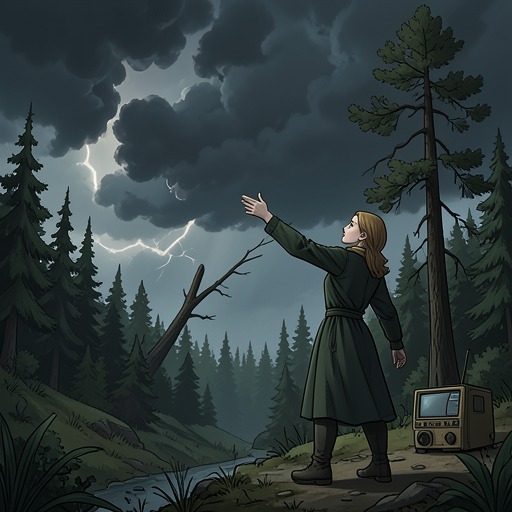
The Unlucky Northwest
The Earthquake BirdThe Unlucky Northwest is a superstition about direction that Lucy Fly makes into a private map of danger and belonging. Its force lies less in any proven power to cause misfortune than in how Lucy is drawn toward places and routes she associates with it: Sado Island, the cold waters beyond it, and the northwestern edge of Tokyo. Geography becomes a way of reading her own susceptibility to bad luck.
The belief and its geography
The directional rule changes with the point of reference. As Lucy learns from Mrs. Katoh, when Kyoto was Japan’s capital, places northeast of the city were considered unlucky; Sado Island therefore acquired a reputation for bad luck and was furnished with numerous temples to guard against evil spirits. Mrs. Katoh had left her husband and son on the island and come to Tokyo seeking better fortune. Lucy wonders whether Mrs. Katoh’s relentless giggle serves as its own protection against badness, or whether it began when she arrived in Tokyo and found Mrs. Yamamoto’s house, with wisteria over the door and music inside.
From Tokyo, however, Sado lies to the northwest, which Lucy regards as her own unlucky direction. The same island can thus be marked by different bearings and histories: the old account looks outward from Kyoto, while Lucy’s personal version begins in Tokyo. The superstition is not a fixed compass rule so much as a frame through which characters interpret departure, luck, and the possibility of escape.
Lucy’s attraction to misfortune
Lucy connects her sense of the northwest to Kinkakuji. She identifies with Mizoguchi, the tragic monk who is warned by a fortune-teller not to travel northwest because it will bring bad luck, and who goes anyway. Rather than treating the warning as a reason to turn back, Lucy feels drawn toward the direction precisely because it promises danger. She sees herself as connected to a place prone to malevolence, making the superstition a form of self-recognition as well as a warning.
That pull accompanies her journey to Sado Island with Lily. At Tokyo Station, the two set out by shinkansen for Niigata, intending to take a ferry onward. Lucy has told Teiji about the plan but assumes he will not come: as far as she knows, he has not left Tokyo since arriving there at fourteen to meet his uncle, Soutaro. She imagines the city as the limitless world Teiji understands through its streets, bridges, and rivers, and thinks he would not want to cross the boundary where Tokyo ends and countryside begins. Her expectation that he will stay behind is also bound up with her belief that she is too strange to be wanted as a companion.
On Sado, Lucy gives the directional idea a bodily dimension. Swimming in the Sea of Japan, she guesses that she is heading northwest and imagines where the current might take her: toward Vladivostok or Nakhodka, and farther north to the Sea of Okhotsk. She then turns south, picturing warmer destinations instead. The cold makes each breath shorter and her limbs stiff, yet she feels intensely alive. Later, she cannot recover that happiness through memory; the water remains imaginable, but the feeling itself has gone. The episode makes the northwest both an imagined route out and a perilous experience she cannot preserve.
Tokyo’s routes and returns
Lucy’s urban wandering gives the directional motif another scale. After Mrs. Yamamoto’s death, she spends time alone in Tokyo and takes the Yamanote Line to a station before walking along the tracks toward the next one. This wandering brings her to Shinjuku, where she first encounters Teiji. She does not describe herself as lonely, but she cannot bear to walk away from the silent, studious young man and return to being alone.
After Lily and Teiji desert her on the cliffs, Lucy sets out from Gotanda and walks counterclockwise through the night, following the railway from station to station. Familiar places summon distinct parts of her life: Akihabara recalls looking at cameras with Teiji; Ameyoko recalls shopping with Natsuko; and other stops bring back earlier meetings and outings. As she continues, the route carries her toward Teiji’s territory. Takadanobaba and Shin-Okubo lie in Tokyo’s northwest, a fact that no longer surprises her. By morning she has walked the distance of a marathon, circled Tokyo, and returned to Gotanda.
The walk does not deliver her out of grief. Its repeated stations instead turn the city into a circuit of remembered attachments, with the northwestern neighborhoods belonging to the territory of the man she has lost. The return to her starting point gives the journey a form of closure without resolving what troubles her: movement can keep her thoughts moving, but it cannot prevent memories from returning.
Meaning and limits
The Unlucky Northwest gathers superstition, literary association, and lived geography without establishing that direction itself causes harm. Lucy’s account makes the belief compelling because she repeatedly chooses movement toward what she understands as dangerous: she accepts the pull toward Sado, swims into cold water along an imagined northwestern route, and walks through the city toward places associated with Teiji. The direction names an attraction to misfortune, not a dependable prediction of it.
Its significance also depends on the contrast between leaving and returning. Sado seems to offer a route beyond Tokyo, while the night walk traces a vast loop inside it; one journey projects outward, the other ends where it began. In both, Lucy uses geography to organize feelings she cannot master. The northwest becomes a personal symbol of risk and affinity, while the circling city shows how far she can travel without escaping the past.